LemmataDigital philology lab

Lemmata · Computational instruments for literary research

Where philology meets measurement.

Lemmata builds scholar-led instruments for the digital humanities, for researchers who work with texts, not terminals. Run supported analyses from your browser with no code, a fully transparent method, deterministic reproducible results, and export of results and records.

Explore the instrumentsAbout the laboratory

Researchers at Ankara University Open source · MIT License LDA languages: English · Italian · French · German · Spanish (Turkish not yet supported) Cite LDA · DOI 10.5281/zenodo.19391729

Two instruments, one discipline.

Each instrument keeps parameter choices visible and states what a result can and cannot mean. Delta also asks you to document the corpus before analysis. Open source, MIT-licensed.

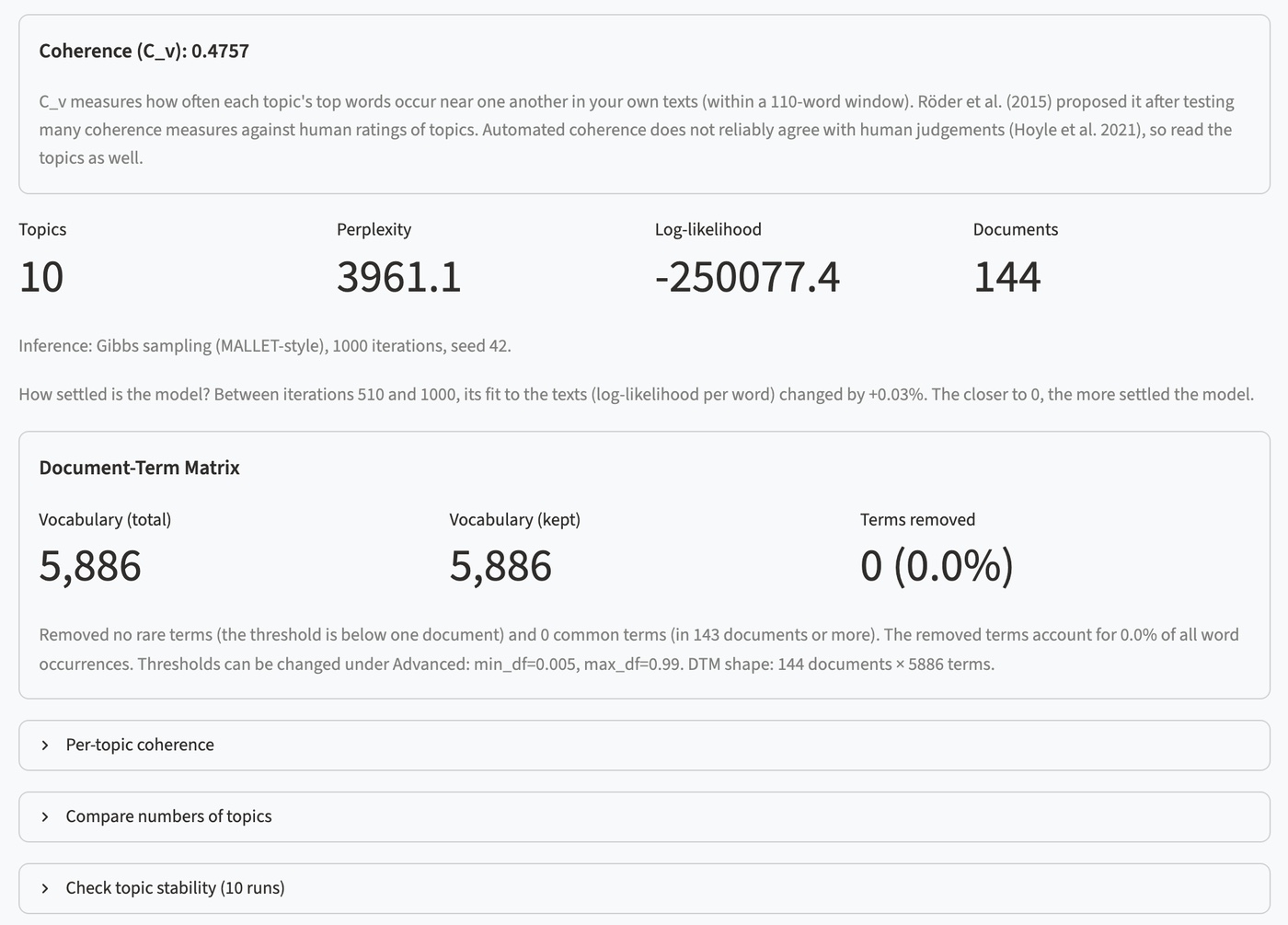
Lemmata LDA, Overview tab: the coherence score (C_v) with an explanation of what it measures, 10 topics and 144 documents from Svevo's La coscienza di Zeno
Topic modeling

Lemmata LDA

Find recurring topics in your corpus with LDA topic modeling built for the humanities. Upload, choose your settings, and explore an interactive topic map and heatmap, topic distributions, and a token-level preprocessing table.

  • 5 languages: EN · IT · FR · DE · ES
  • Deterministic, reproducible
  • Export: CSV · PDF · ZIP · heatmap PNG/SVG
  • Gibbs sampling by default
Live · lda.lemmata.app
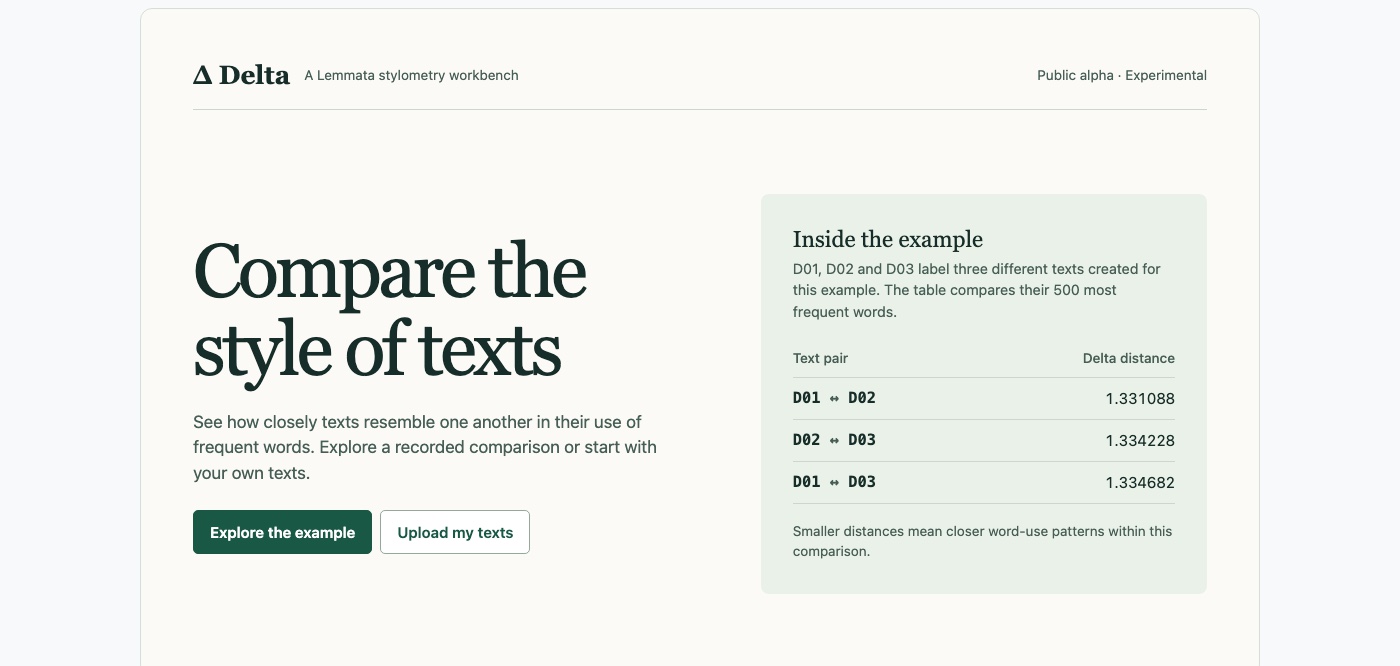
Delta stylometry workbench interface
Stylometry

Delta

Compare recurring language patterns across texts, groups, and time with an uncertainty-aware stylometry workbench. Guided most-frequent-word settings, a distance matrix as the primary evidence, and every limitation kept visible.

  • Compare texts · groups · over time
  • 100 · 300 · 500 · 1,000 MFW together
  • JSON and CSV run records
  • Alpha: at most 50 texts per run
Public alpha · delta.lemmata.app

Built for researchers, not terminals.

The same discipline runs through every instrument.

No code required

Choose your settings and run analyses from your web browser, with nothing to install and no scripting. The analysis itself runs on the server that hosts the app.

Transparent method

See exactly which tokens were kept, removed, or lemmatized, and which parameters and limits shaped a result.

Deterministic

In LDA, the same data, settings, random seed (42 by default), package and language-model versions, and processor type give the same result. Your settings, the main package versions and the processor type are recorded in an environment report, which the PDF report and the ZIP archive also contain.

Export your results

LDA results download as CSV tables, a PDF report and a ZIP archive, and the heatmap as PNG or SVG. Delta provides its corpus and analysis records as separate JSON and CSV files.

Built on trusted open sourcespaCy lemmatization · tomotopy & scikit-learn topic modeling · Gensim coherence · R stylo stylometry · Streamlit interface

A laboratory, not a black box.

Lemmata is an open, method-first laboratory for computational literary studies, developed by researchers at Ankara University. Every instrument states its boundaries: measurements describe patterns within a documented corpus, and interpretation remains the researcher's responsibility.

Research team · Oğuz KoraniD · Barış YücesaniD · Hakan CangıriD

Contact · koran@ankara.edu.tr · Report a problem · LDA · Delta

Cite Lemmata LDA

@software{koran_lemmata_2026,
  author = {Koran, Oğuz and Yücesan, Barış and Cangır, Hakan},
  title  = {Lemmata: A Multilingual LDA Topic Modeling Platform for Digital Humanities},
  year   = {2026},
  doi    = {10.5281/zenodo.19391729},
  url    = {https://lda.lemmata.app}
}

DOI · 10.5281/zenodo.19391729

Using Delta? Its citation is on the Delta page.